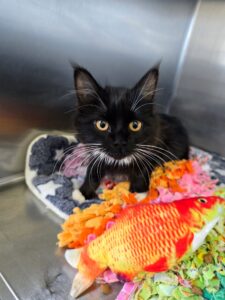
 Looking for a feline friend to help keep critters away from your property? Fill out our barn cat form to get on our list. We’ll contact you when one (or more) become available. Please be sure you’re ready to set them up for success. See tips below!
Acclimating working cats
HSO’s community cat TNVR (trap-neuter-vaccinate-release) program is dedicated to helping curb the overpopulation of community cats in and around Crook County. Our barn cat program serves to match feral cats with residents who can offer a safe, warm, humane space in exchange for a working cat who will help rid your property of rodents.
Similar to adopting an indoor companion, giving a home to a community cat does come with the promise of providing a lifetime of care for these cats that otherwise face a rough future. Here’s how to set them up for success on your property!
Bringing Barn Cats Home 🏠
✔Provide an enclosed, inescapable place to house the cats for a minimum of 4 weeks while they become acclimated to their new environment.
A feral cat can easily escape even the smallest opening, so please make sure there are no gaps, holes, spaces with dirt floors, cracks, loose boards, or chicken wire.
Acclimating (minimum 4 weeks) 📆
✔Place food, water, litter, and a bed in this area to help them learn where their home base is. Place the bed inside a box or other enclosed area where they can hide and feel safe. A wire dog crate can even serve as a temporary home, provided it is also within a confined space.
✔Provide delicious and appealing food during confinement to help cats feel comfortable in their new home. Consider adding enticing wet food with dry.
Confinement is essential and critical to successful relocation. Confinement in a large, spacious enclosure allows the cats to adjust to the environment in safety and accept it as their new home. If cats are set free upon arrival, they may attempt to return to their former outdoor home, and will likely be lost. The cats may try to find a way out the first day or two, but will settle down once they realize they’re safe and have regular food and water.
🙀 If a cat escapes from the enclosure, the new caregiver should set food and water out in the same area. This will encourage the cat to stay close. The caregiver can also sprinkle that particular cat’s used litter (specifically feces) around the location. Since cats have a keen sense of smell, this will help lure the cat back.
Work Release 😸
✔When it is time to release the cat(s), quietly open the door and leave. Let them explore their territory on their own terms. Please do not release them in inclement weather, or before a minimum of 4 weeks!
✔Continue providing a delicious mix of wet and dry food, as well as keeping the litter box out to attract your cat(s) to stay in the area.
✔ If you have dogs, it is best if you keep them away from the cats so they aren’t chased away.
Permanent Home Day to Day
✔Straw is a good insulator and makes good bedding to keep cats warm in cold weather. It is important for cats to be able to stay warm and dry especially during our cold Central Oregon winters.
✔Continue to provide food and water
Keep an eye on the water in winter as it has the potential to freeze over. Heated water bowls are a great option.
Here to Help
☎️For questions, please call HSO 541-447-7178 Tues-Sat 10a-4p, email volunteers@thehso.org, or visit this website for more tips
Additional information and instructions for building feral cat shelters can be found on the Neighborhood Cats website at neighborhoodcats.org
THANKS FOR SAVING LIVES!